After having spent 15 years working with private 4G/5G networks and Wi-Fi, I took a break from the industry almost two years ago. It was moving too slowly, projects dragged on, customer dialogues as well, people did not respond to quotes and could not make decisions, and other things came up in life that felt more exciting to spend time on.
But this spring, I got the interest back, and got curious about what had actually happened in the Swedish 5G market during my absense. To find out, I initiated a study that has been simmering on low heat over the past six months. Through contacts with fellow industry experts and former colleagues, network equipment vendors, and a large number of customers, a picture has emerged of what the situation actually looks like. The goal was to find out whether private 5G networks have finally started to take off in companies or whether it is still mostly something discussed in meeting rooms and PowerPoint presentations. And, of course, what we can do to accellerate the market for private 5G networks in Sweden.
Executive summary – the article in brief
The article is a summary of a six-month market study of the Swedish market for private dedicated 4G/5G networks. The study is based on 15 years of work with dedicated networks in production and enterprise environments and interviews with manufacturers of 5G equipment, sawmills, warehouse/logistics companies, harbours, various industries, mining companies, and manufacturers of 5G-connected devices.
Despite the fact that in Sweden it has been possible to apply for its own so-called industrial spectrum to build private 5G networks since the autumn of 2021, the number of production-deployed networks is only just over 20 in the country. This is remarkably low, especially given Sweden is a "telco vendor country" and what the global private 5G market looks like. However, the spectrum allocation list (which is public) shows that the market has begun to move for larger industrial companies.
What has made the development slow is a lack of understanding among many companies of their own operations and of what the value of reliable connectivity in a production environment actually provides, but also that the business case for building a private network is often missing.
What can accelerate the development is a shift towards more demanding production systems and production environments, but also that companies gain better understanding of their production environment. The recommendation is to do this through pre-studies that look at everything from use cases to the requirements and needs of the business and IT, and what the real costs of having a wireless infrastructure that is too poor actually are. If the pre-study shows that private 5G is the right path to take, the next step is to look at the alternatives to find the right type of solution. But everything starts with understanding one’s own needs.
What is private 5G and what does the market look like in general?
Private 5G (or private 4G, the differences are smaller than one might think) is a dedicated 5G network that a company or organization to some extent owns and operates itself in its production environment (often referred to as Operational Technology, “OT environment”), instead of using a mobile operator’s public network. In short, this means that only selected users and devices are allowed to connect and that higher security and control can be achieved.
Private 5G networks are often well suited for manufacturing environments where alternative technologies such as Wi-Fi lack the mobility, range, reliability, and deterministic behavior required to handle robots/vehicles with emergency stop functionality, wirelessly connected Programmable Logic Controllers (PLCs), mobile handheld devices, Internet of Things (IoT) devices, and so on. 5G networks also come with built-in, certificate-based security, something that many Wi-Fi networks and Wi-Fi devices do not support.
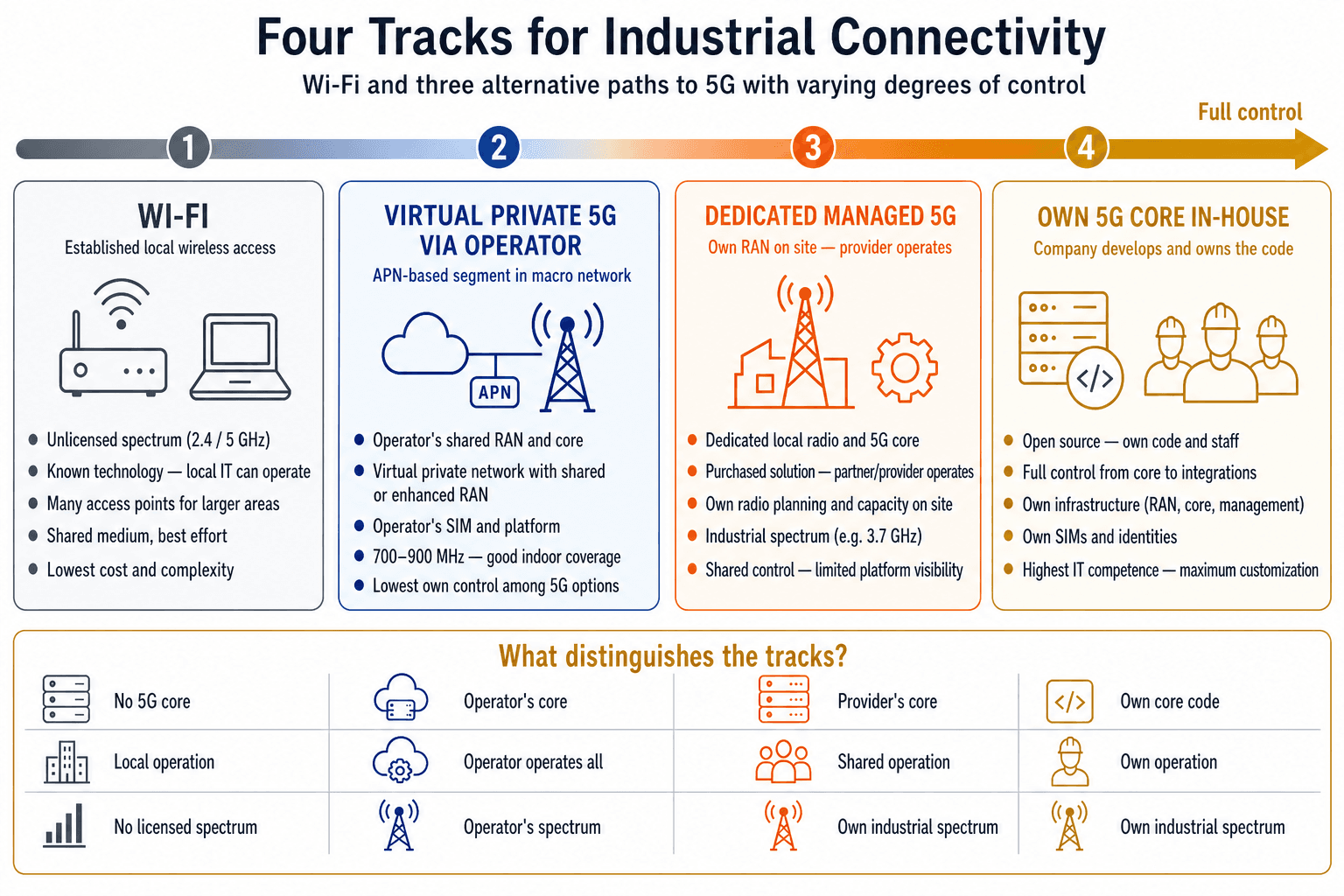
Exactly how private 5G networks are built and delivered varies. A mobile operator would likely argue that a segment of their public macro network (often called an “APN”, Access Point Name in 4G, or “DNN”, Data Network Name in 5G, which can be compared to an "SSID", Service Set Identifier in a Wi-Fi network) can be considered a “private network”. It is to some extent, and it is a solution that works well for many types of customers, but it is not as private as a managed 5G service that is installed and possibly operated in-house on dedicated industry spectrum. And that option is in turn not as private as choosing to develop your own 5G core network based on open-source software and keeping everything in-house (which this article is about). Developing your own solution is of course not suitable for all types of organizations, but if you want full control, maximum security, and to own your own code, it is a possible path.
The figure below compares Wi-Fi with the main alternatives when building production networks using private 5G. There are of course also variations of these.
Exactly what a private 5G network is depends on who you ask. To illustrate this, we can look at this study published by the analysis firm Berg Insight at the end of 2025, which showed that there were approximately 6,500 private 4G/5G networks globally worldwide (up from 4,700 networks the year before, i.e., an increase of almost 40%). At the same time, there are indications that there are as many as 64,000 private 4G/5G networks in operation in China alone. However, these networks are largely delivered as virtual operator networks as part of a macro network (see the figure below), and the difference in the statistics is therefore as mentioned a matter of definition.
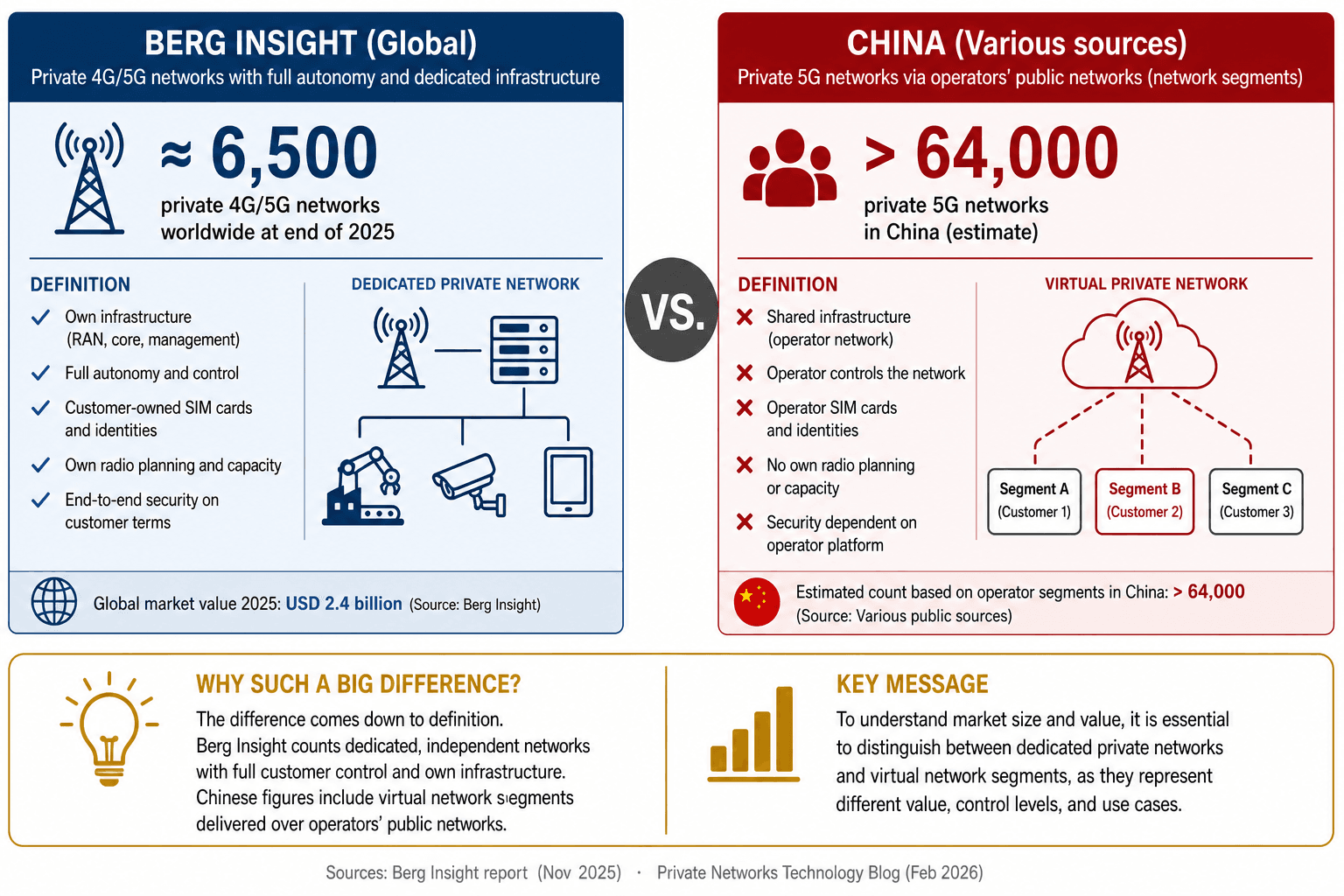
The survey I have conducted of the Swedish market does not take virtual networks into account. To be classified as a private 5G network in this study, the network must be dedicated. It should preferably be built entirely for the customer in the customer’s environment, use spectrum that is not used in the surrounding macro network in the same area (i.e. there is no risk that a passing busload of tourists affects the operation or the emergency stop function of autonomous vehicles in a factory), and it should be capacity-planned and designed to handle the customer’s use cases. Base stations built in this network should be able to have as long a battery backup as the customer requires. In a public macro network, this backup is typically a couple of hours as specified by the local regulator.
The private network should also be able to be fully autonomous without external dependency on an operator’s central core network components. Security, segmentation, SIM/eSIM management, and so on should be under the control of the network owner (typically the customer’s IT department).
Private 5G networks in Sweden
In Sweden, the Swedish Post and Telecom Authority (PTS) released 80 MHz of so-called “industrial spectrum” in the 3.72–3.80 GHz frequency band in the autumn of 2021. The idea was that industries, mines, ports, and hospitals would be able to apply for their own local spectrum to build 5G networks via a simple application process. Recently, information was published that work is underway on a consultation aimed at increasing the amount of spectrum to 400 MHz in the 3.8–4.2 GHz frequency range, in line with the European Conference of Postal and Telecommunications Administrations (CEPT) initiative to harmonize this spectrum for industrial use in Europe.
Over the nearly five years since the first 80 MHz was made available, about 130 allocations have been made (June 2026), but many of these come from the same organizations. The highest number of allocations, 24, is held by Region Västra Götaland, which has applied for permits across several different hospitals. The list (which is public) also includes, among others, ports, petrol stations, mines, sawmills, and manufacturing companies, but these are only single applications that are often made for the purpose of testing technology or running pilots. The same applies to many of the networks that have actually been built. There are a number of production environments, but they are few and far between.
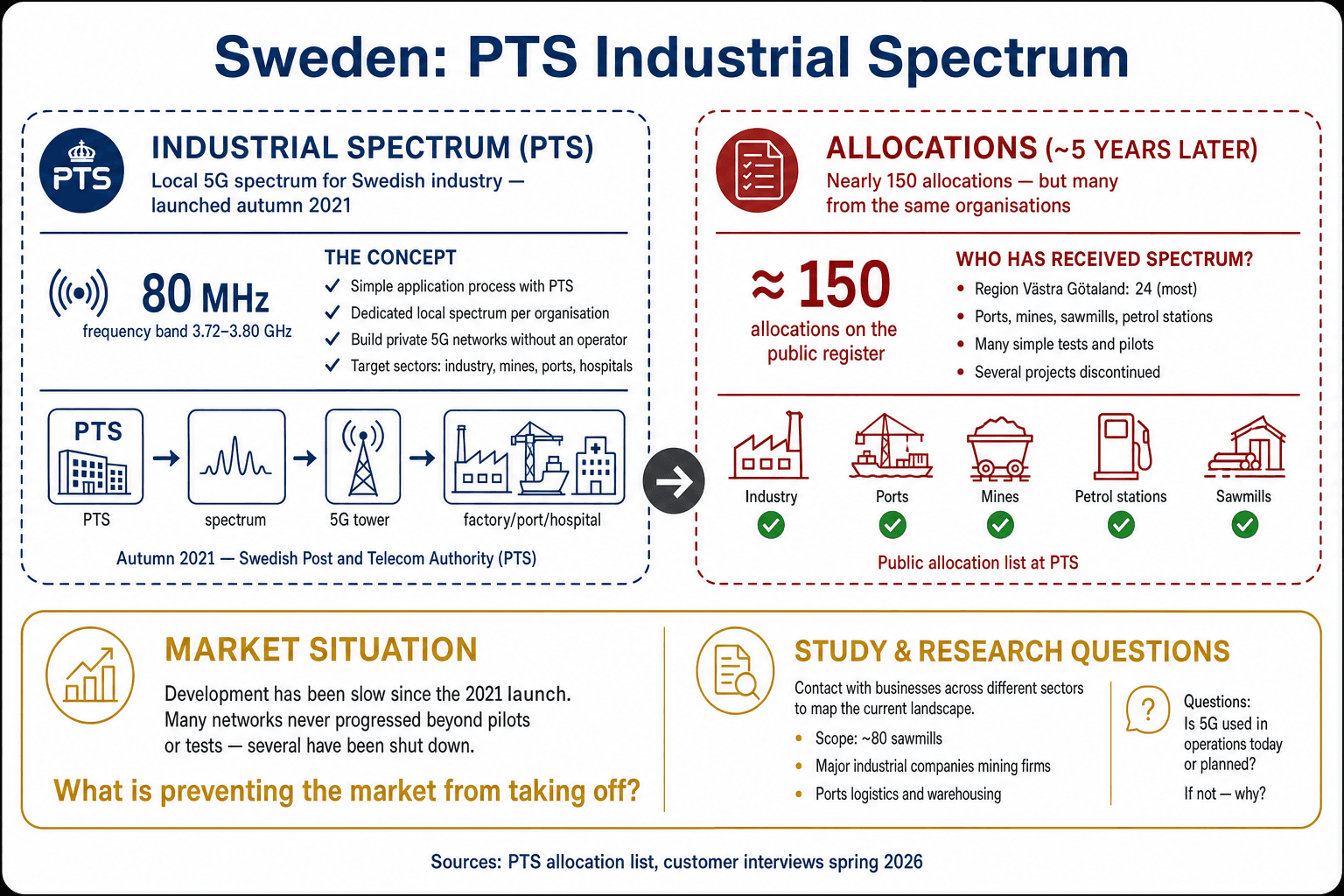
There are also a number of private networks that have been built for, among other things, sawmills, mines, hospitals, and open-pit mines, where a mobile operator has used its own spectrum to deliver either (enhanced) virtual or fully private networks. But even here, it is easy to count the number of operational installations. We are talking on the order of 20–25 production networks in Sweden. This is remarkably low considering:
- How expectations for this market looked five years ago, and that there are 6,500 commercial networks globally today (excluding pilot installations).
- That we have one of the world’s leading manufacturers of telecom equipment and a large number of skilled people who can build telecom and IT networks in Sweden.
- That we have plenty of mines/open-pit mines, automotive industry, heavy manufacturing industry, forestry industry with 130 sawmills, defence industry, logistics companies, and many ports where there are vehicles, sensors, handheld devices, video cameras, and drones that need to be connected in OT environments.
Looking at the list of license allocations, it can be seen that things are slowly starting to move. Companies and organizations such as SAAB, Stegra, Volvo, FMV, ABB, Forsmark and LKAB have all applied for local industrial spectrum licenses over the past six to twelve months. This indicates that interest and maturity are increasing for building private 5G networks in production environments.
But, the question is still what has made Sweden so slow in building these production networks. Why are we not keeping up and embracing new technology when it is available and being rolled out in other countries around the world? The research question for the study was therefore whether the companies I spoke to are using private 5G in their operations today, or whether they plan to do so in the future. And in cases where they had no interest, I also wanted to know why.
Scope of the study and this article
The interviews covered a wide range of customer types, including mines and ports, but in this article I will focus on the following vertical sectors:
- Sawmills. Interesting because we have a large amount of forest and sawmills in Sweden, and environments where there is a lot of movement of trucks, wheel loaders, and so on.
- Warehouses. A lot of things moving around and increasing automation is driving interest in building private 5G networks.
- Industrial companies with production environments where 5G is often a good fit. Here, tests are being conducted at, among others, SAAB to replace PLC communication over cable with 5G.
- Manufacturing companies developing cameras, tools, or IoT devices that need a 5G network in order to be connected. They might not need 5G in their production environments, but their customers do.
Sawmills and warehouses
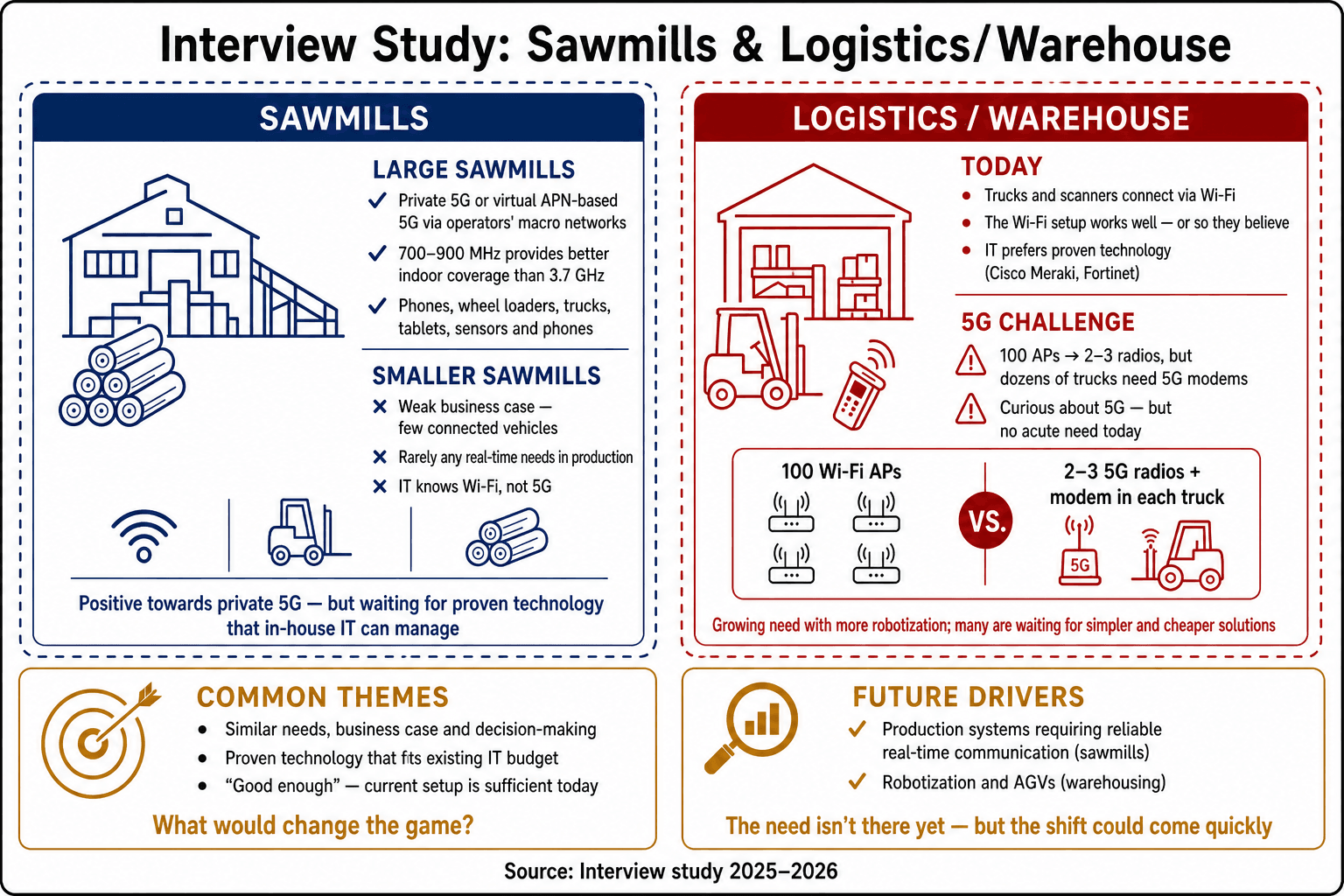
Even though sawmills and warehouses may sound like very different types of operations, they are actually more similar than one might think when it comes to production networks. The business cases and willingness to invest look similar in these industries. In many cases, companies currently rely on a Wi-Fi infrastructure that “works well enough” and “does not cost anything,” and therefore there is little interest in making changes.
Large sawmills with few connected vehicles and without demanding production systems often choose to remain on Wi-Fi, or to run a virtual private 5G network (via APN/DNN) with an operator, sometimes by also improving indoor coverage through simple repeater solutions. Operator networks also provide coverage for regular phones that sit outside the OT networks. There are also sawmills that have indoor operations where, for example, body cameras need to function, and in those cases it is advantageous to use operators’ lower frequencies to achieve better outside-in coverage.
Smaller sawmills often simply see no business case in building their own 5G infrastructure. They have too few connected vehicles, no production systems that require real-time communication, and they have local IT expertise that can handle Wi-Fi but not 5G. Alternatively, they have outsourced IT operations to smaller system integrators who either cannot or do not benefit from 5G and have no interest in bringing the cat into the room. There are a few exceptions among sawmills, such as Fiskarheden in Sälen, which is very forward-leaning and has advanced production with modern production systems where downtime and disruptions in connectivity can become costly. But for most, a Wi-Fi network with nomadic connectivity is sufficient.
In the longer term, many sawmills are positively inclined towards private 5G. They generally want these networks to be locally deployed, like today’s Wi-Fi networks, not delivered via any public infrastructure, but they do not want to build them until the technology is proven and tested by others, and they want it to be so easy to use that their own IT department can manage it without the involvement of third parties.
In warehousing/logistics, it is also common for forklifts, handheld scanners, and handheld devices to be connected over Wi-Fi. As an example from a pre-study I conducted a few years ago, 80 Wi-Fi access points could advantageously be replaced by 2–3 5G radios in a warehouse of approximately 4,000–5,000 square meters, but at the same time the forklifts would need to be equipped with a 5G modem each. Here, the IT department prefers to work with proven technology from companies such as Cisco (Meraki) or Fortinet, even if it is inferior. They understand troubleshooting and configuration, and support is absorbed into existing IT budgets.
These logistics companies generally feel that their Wi-Fi environment works okay, and although they are curious about 5G and believe the technology could provide them with a better production environment, they also say that the existing setup gives them sufficient functionality and that the real need for a more robust network with good mobility is currently lacking. There is also a fear of using new technology where they lack their own knowledge and support.
What sawmills and warehouses have in common is therefore mainly that for many customers there seems to be no business case for upgrading the production environment with a better network. However, this conclusion is based on the assumption that these operations actually know what the cost of running on a suboptimal network is. What does a production stop cost? What does it cost to patch access points, run cables, install 10–20x more radios? What does the support for Wi-Fi networks cost, and what does it cost in man-hours per year when the networks do not function as they should? My experience here is that this knowledge is often not available. The focus is on the price tag when the network is acquired/purchased, but not on the actual costs associated with running the wrong type of infrastructure. Imagine you bought a new car and only looked at the price tag, not taking into consideration what kind of fuel it uses, how many kilometers you drive per year and if there are charging stations in your country. Quite some risk you end up with the wrong car.
What could drive the need for more 5G among these two types of customers is new production systems that place higher demands on reliable real-time communication, increased use of automation and Automatic Guided Vehicles (AGVs), a higher degree of predictive maintenance, and AI-driven production. A greater understanding of how production actually works and what downtime costs would also drive interest in better networks.
Industry category: manufacturing companies
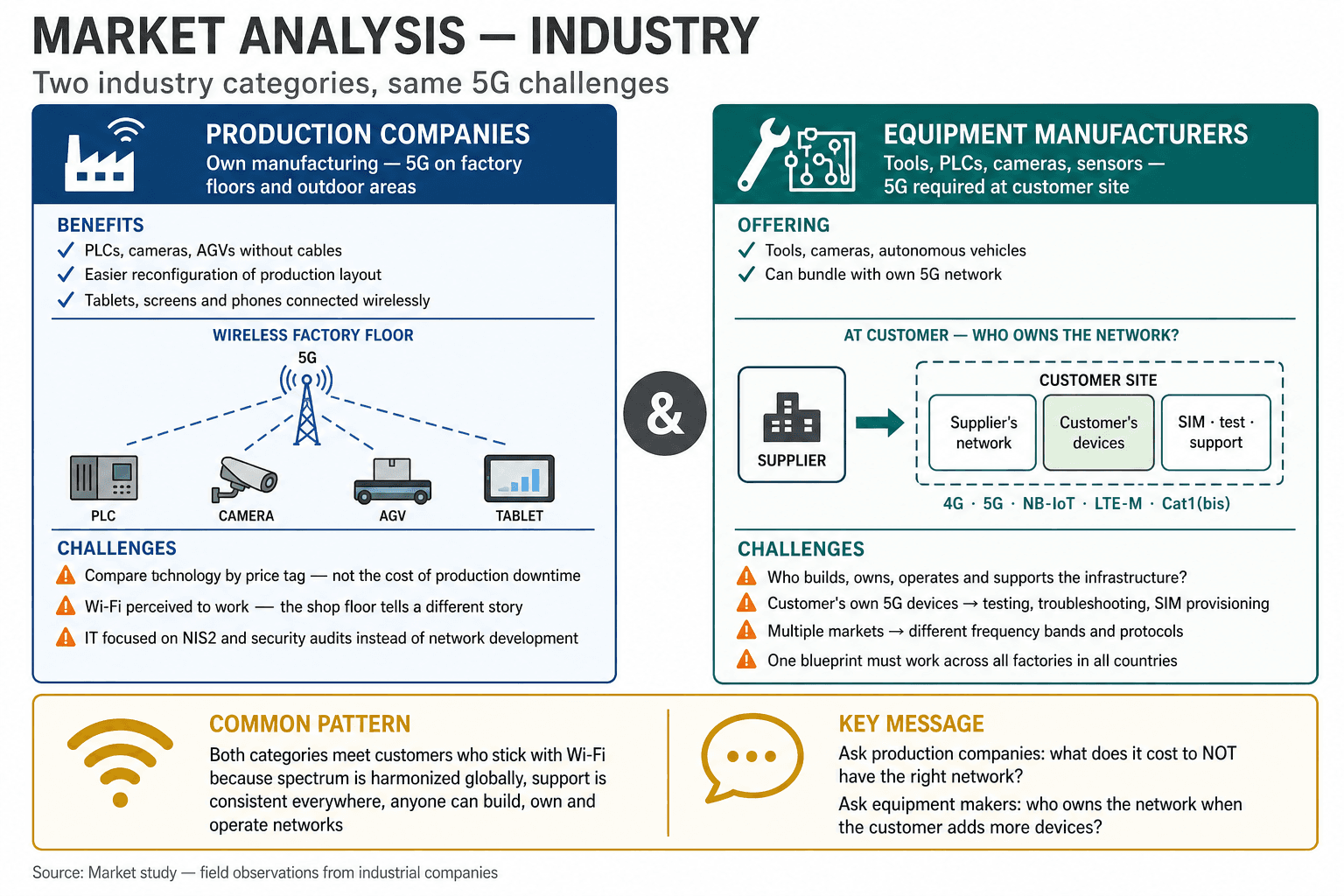
Within the “industry” segment, we primarily find companies that can use private 5G in their own OT environment, such as factories, mines, or production lines where there is a need to connect PLCs, cameras, Automatic Guided Vehicles (AGVs), robots, scanners, and much more, and eliminate cables that are expensive to install and replace. By removing cabling, it also becomes easier to rearrange production areas as needed, something that several companies show interest in.
The general challenge is that these companies often compare technology based on its price tag rather than conducting pre-studies to find out what it costs not to have a network in place that prevents production stops and lost working time. Just as for warehouses and sawmills, several companies I have talked to in the industry segment assume that Wi-Fi works well on the factory floors, but when you then ask those working there, you get a different picture.
Several of these companies (especially the IT departments) also talk about prioritization challenges. For example, several companies mentioned during the study that security assessments and, in particular, NIS2 certification work take up a large part of their focus, and that they therefore do not have time to focus on their core tasks and spend time figuring out how their networks need to evolve.
An adjacent category of industrial companies is those that manufacture 5G-connected devices. This includes cameras, tools, handheld scanners, autonomous vehicles, and other equipment that requires a 5G network to be in place at the customers who are to purchase these products.
The challenges here are several. Who should build, own, operate, and support the 5G infrastructure? As a manufacturer of a tool, you can bundle it with your own 5G network, but who takes responsibility for it? And once it is in place, the customer may introduce other 5G devices or IoT devices that require different frequency or protocol support than the network was built for, and then someone must take responsibility for expansion, testing, verification of communication, troubleshooting, SIM provisioning, and so on for this new range of devices. Furthermore, tools, vehicles, and other connected devices need well-matched and well-designed antenna solutions in place; otherwise, the networks that have been designed and deployed at customer sites for one type of device will not provide the coverage and bandwidth expected for devices with poorer antennas.
If these companies sell their products across multiple markets, additional challenges arise regarding which frequency bands and radio protocols must be supported (4G, 5G, NB-IoT, LTE-M, LTE-Cat1bis). Customers with production in different countries often want to stick to a blueprint that applies to all factory floors, and in that case the lowest common denominator across all markets is often called “Wi-Fi”. Here too, many customers therefore continue to use Wi-Fi networks, mainly because it is harmonized spectrum with the same support in all countries and because anyone can build, own, and operate the networks.
How do we accelerate private 5G networks in Sweden?
If we summarize the situation for Swedish industrial companies, sawmills, and also logistics companies, and at the same time compares it with the rapid deployment of private 5G networks in China and the rest of the world, it becomes clear that there is a significant untapped potential to strengthen Sweden’s competitiveness. Companies that are considering moving towards better OT infrastructure need to launch a two-stage rocket as outlined below.
Step 1: Understanding your own operations
The first step is to identify what actual need you have for private 5G. This often requires a pre-study where one reviews use cases, how processes and production downtime look in production, what the cost base looks like for the current Wi-Fi infrastructure (including operations and support), whether new production systems or tools are being introduced that require the infrastructure to be deterministic, which applications need to be able to run on-premises, and so on. But be careful, if you ask someone who sells 5G to carry out this study, chances are the study will tell you to buy 5G. If they sell Wi-Fi, the study will tell you to go for Wi-Fi.
A proper study looks at the IT/OT/IoT architecture, sorts out how the Zero Trust environment with segmentation and authentication should look, how the strategy for autonomous production with local survivability is intended to work, and how IoT devices reach their IoT platform. Based on the results of this review of the Swedish market, such a pre-study will lead to a company ending up in one of the four categories illustrated in the figure below.
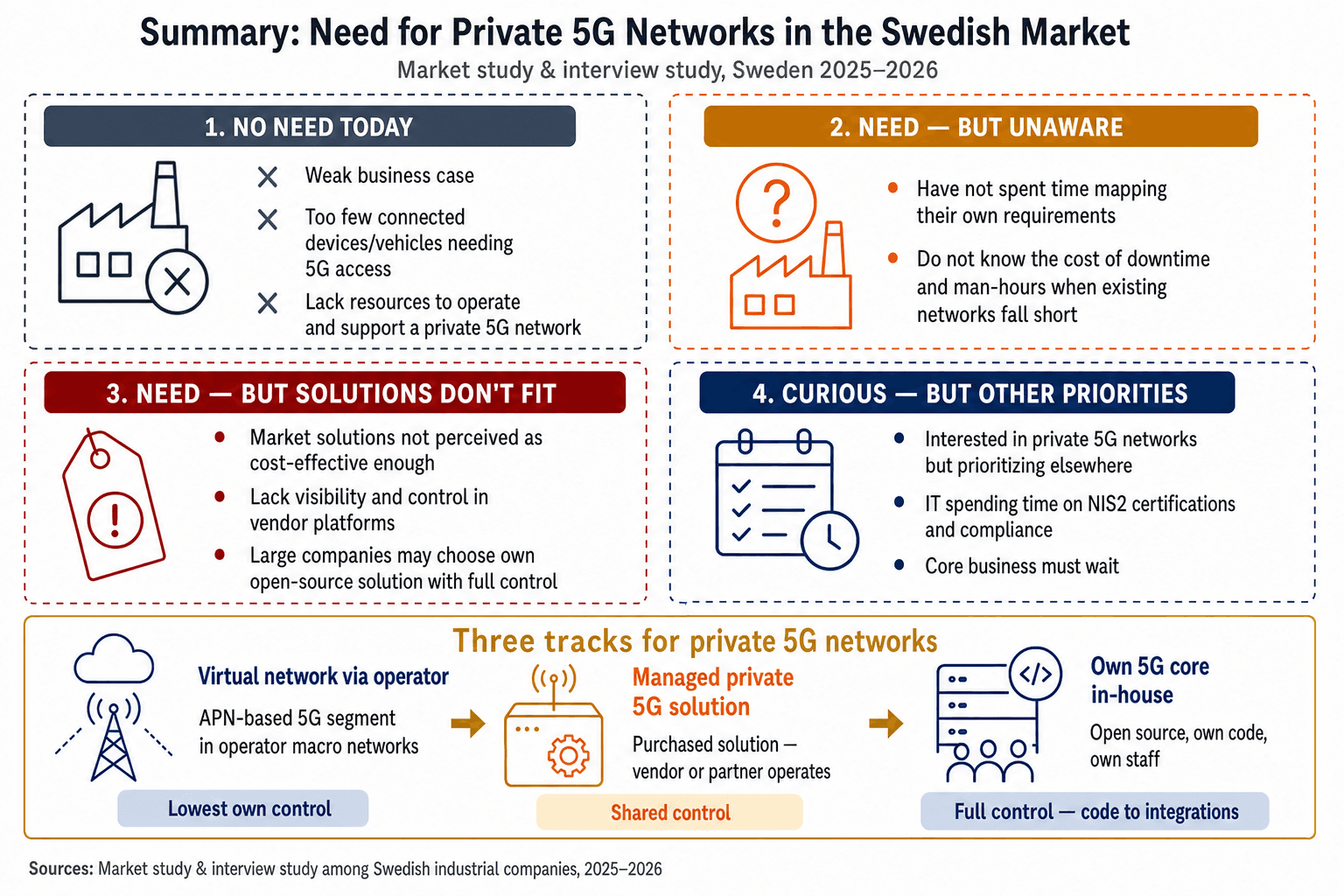
Category 1: There is no need for private 5G today. Wi-Fi or public 5G works great as is. This is very useful to know, as it means you can stop running pilots or spending time in meetings with 5G network vendors. If the need changes over time, it can be revisited.
Category 2: There is a need, but there is no awareness that it exists. This is where many of the companies I have worked with historically are situated. If you does not understand what the need looks like (or that it even exists), you also become a very poor buyer, which often shows up in failed pilot projects. Have seen quite a few such project within both private 5G and IoT over the years. A pre-study will highlight the existing needs and show what investment and return on investment (ROI) for private 5G infrastructure would be if it is built in a decent way.
Category 3: There is a need, but the available private 5G solutions do not fit. They may be too expensive, not considered secure enough, or they require hiring resources with experience working with mobile networks, and it is not certain that this fits within any budget. In these cases, a pre-study can help identify alternative paths forward.
Category 4: Here we find the companies that are fully occupied with their compliance investigations or other matters and do not have time to focus on their core tasks (to support the business operations). A good pre-study that demonstrates high ROI in production if the network question is given some attention can give these organizations a reality check and help them prioritize.
Step 2: Determining the direction forward
If the pre-study of the organization’s operational and IT needs shows that a private 5G infrastructure is required, the next step is to look at which of the alternative 5G paths is most relevant. It may be that a virtual private 5G network is the best fit. Or it may be that a managed service is needed. For some organizations, the most relevant option will be to develop their own 5G solution, in which case they may need help finding the right organization and resources to bring it to completion.
Site surveys, traffic models, ROI models, network High-Level/Low-Leve Designs, vendor selection and other things are carried out and documented. Maybe another article later on, getting done with this one. ;)
But everything starts with understanding what the need looks like. If you want help with that part, BWireless is the right partner. Just get in touch!
*) You are free to use the text and images in this article, but please include the source.